
To Make a Song
The poetry of Enid Shomer

[adapted from my Introduction to Shomer’s Riptide: New and Selected Poems (Blair 2026)]
In “Jazz at Bradley’s,” Enid Shomer writes of “the darkness / that must be swallowed to make a song.” As we read through Riptide: New and Selected Poems, Shomer’s sixth poetry collection spanning forty years, we get a good sense of the darkness she has experienced in her life. She is the daughter of a cruel father. Growing up at a time when women’s roles were narrowly prescribed, she was an independent, ambitious, brilliant young woman. As we learn in the new poems, she has been living with serious health challenges. She has swallowed plenty of darkness, but fearlessly facing darkness alone isn’t enough to make a song. To make a song, one must have a fierce dedication to craft along with an unwavering discipline. It doesn’t hurt to have some talent, too.
A close look at the first quatrain of “Jazz at Bradley’s” gives us a sense of the many facets of language Shomer draws on in creating one of her powerful poems.
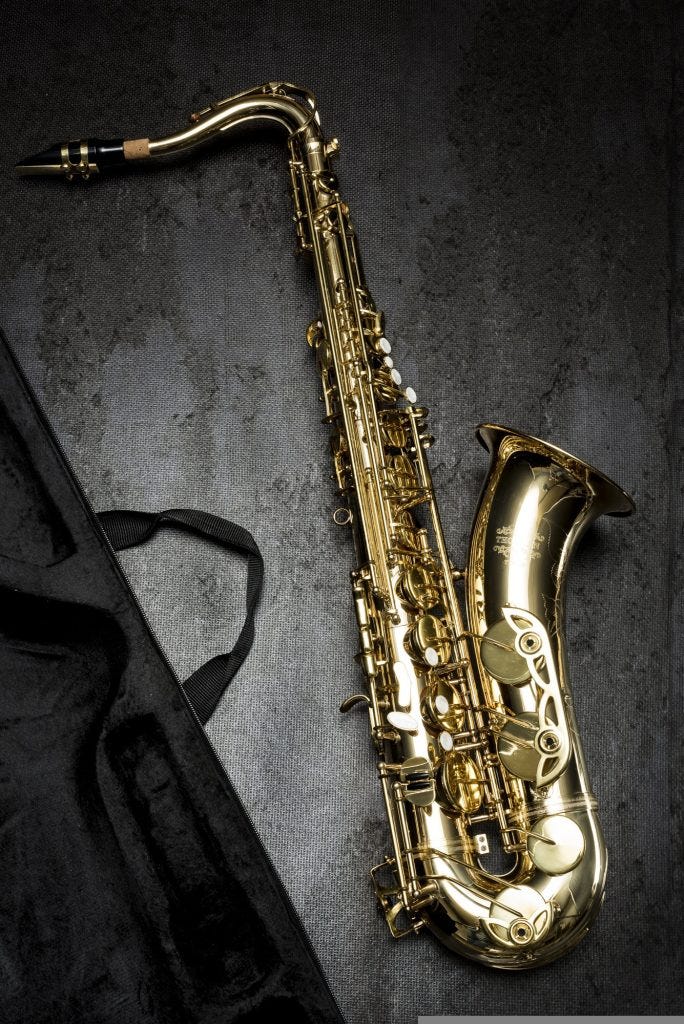
Between sets the brass swan
sleeps propped against a wall
long neck drinking in the darkness
that must be swallowed to make a song
Note the gorgeous extended metaphor for a saxophone: the long-necked swan leaning against a wall drinking. We can also read the sax as a metonym for the saxophonist drinking between sets. Note, too, the little marriages of words, joined by repetition and variation of sounds: “swan” and “song,” “sets” and “neck,” “between” and “brass,” “drinking” and “darkness,” “swallowed” and “song.” The quatrain concludes with what we experience as a complete thought: “the darkness / that must be swallowed to make a song.”
The poem’s second quatrain begins, “digress from melody…”. And there it is! The moment the poem itself digresses from its equivalent of melody. Even without closing punctuation at the end of the first stanza, we experience a sense of closure. But then, after a silence (the stanza break), after a brief rest (an eighth of a beat, say), we find ourselves thrust in a new direction: a digression from melody into improvisation. Jazz.
There are many kinds of digressions from “melody” in Shomer’s work. Consider her poems from Stars at Noon: Poems from the Life of Jacqueline Cochran. Cochran, an autodidact who learned to fly in 1932, “held more speed, distance, and altitude records in her lifetime than any pilot of either sex.” In “Photograph with Amelia (Indio, California, 1935),” a villanelle, Shomer has Cochran say, “to fly like a man, you must dress like one, pose / your limbs loosely, take up more room than a rose / on a thorny stem.” Given the gender norms firmly in place when she lived, Cochran knew exactly how to improvise to create the life she wanted.
As she writes in “For the Girl Who Sat in Front of Me,” Shomer has chosen to devote her life to “pushing words around.” It’s not surprising then that she would be drawn to record-breaking aviator Cochran’s interest in language itself. In “The Heaven of Names,” a letter poem, Cochran addresses Mr. Dudley Cloud, former director of the Atlantic Monthly Press.
Until now, I’d grabbed at words
like doorknobs. Thank you
for teaching me to savor them like wine.
‘Thank you’ is so lame!
I’m shipping a bushel of dates
from my ranch, sweet
syllables in any tongue.
Here, Shomer gets straight to the challenge facing any poet: how to make words as sweet as fruit or as earthy or floral as wine. In poem after poem, Shomer meets that challenge. Whatever the subject—the natural world (especially the beaches, waters, and skies of Florida), troubling family relations, desire, health, medical care—her poems are grounded and brought to life in vivid, sensory details and strong lyrical-narrative drives.
It takes courage to choose one’s life, whether you are Cochran or Shomer or Shomer writing in the voice of Cochran. It’s not a contradiction to say that as much as Shomer chose her life she was at the same time chosen. She was called to poetry. “Pausing on a Hillside in Anatolia” begins with a memory of an experience in Turkey. Having been captivated by bells resounding on the necks of goats, Shomer samples many different bells in the bazaar in Istanbul, hoping to “buy the music” and bring it home with her to Florida.
As the poem continues, she recalls a much earlier experience of “feeling called, when the college carillon / tolled at dusk.” This gives rise, a little later in the poem, to another memory:
Sometimes when I sang
in choir, I felt the bones of my skull
buzzing, music passing through them
like drone strings, my own voice
inaudible in the rainbow of sound
we hung from the rafters. I had to hold hands
with the girl beside me for the highest
soprano riffs, I was so dizzy
with the bliss of blending in.
This memory prompts yet another memory, that of learning about the Aeolian harp. Favored by the Romantic poets, the Aeolian harp, “toy and metaphor,” was “placed in a window where gusting breezes / strummed a pensive music that came / from nature, not art.” Percy Bysshe Shelley “believed the poet / is like the wind harp, and life / the wind that plucks his harmonies, / his poems.”
Having traveled from recent to distant memory, Shomer returns to her present life:
Well, I have lived in a punishing wind
for years now, but how many bells
could I summon?
Count the number of poems in Riptide. That’s at least as many bells as she has summoned so far!
Through it all, darkness and light, Shomer has been singing. In “Rara Omnia,” she expresses her wish for the afterlife, if indeed there is an afterlife.
If there’s life after death, it isn’t the body
I’d want, which after all is a rather shoddy
container. I’d want to come back as pure voice.
I’d want to tell of this beach before the turtles
confused the porch lights for moons as they hurtled
ashore to lay their eggs.
Turning to the poem’s conclusion, Shomer writes,
If I could come back . . .
. . .
I’d send my voice like a whale song into the deep
threading it through turtle grass and sea wrack
singing to the soft corals and sea hares, the polychete
worms and squid, Come back if you can, come back.
The human body may indeed be shoddy. But the bodies of Shomer’s poems are strong. Thanks to the clear, compelling voice of her poems—thanks to the darkness she has swallowed and the songs she has made of the darkness and light—Shomer’s voice will continue to sing to us for as long there is poetry, as long as there are readers, as long as there are beings around to listen.
Richard Chess has published five books of poetry, the most recent of which is The Loneliest Monk. Professor emeritus from UNC Asheville, where he directed the Center for Jewish Studies for 30 years, he recently stepped down after five years of service on the board of Yetzirah: a Hearth for Jewish Poetry. You can find him at www.richardchess.com.
We invite you to learn more about Slant Books here.
 | A guest post by
|
Thank you for this fine post. I was not aware of Enid Shomer and am grateful for your introduction to her poetry.