
Remembering Robert Coles
On the seemingly effortless wedding of medicine and writing


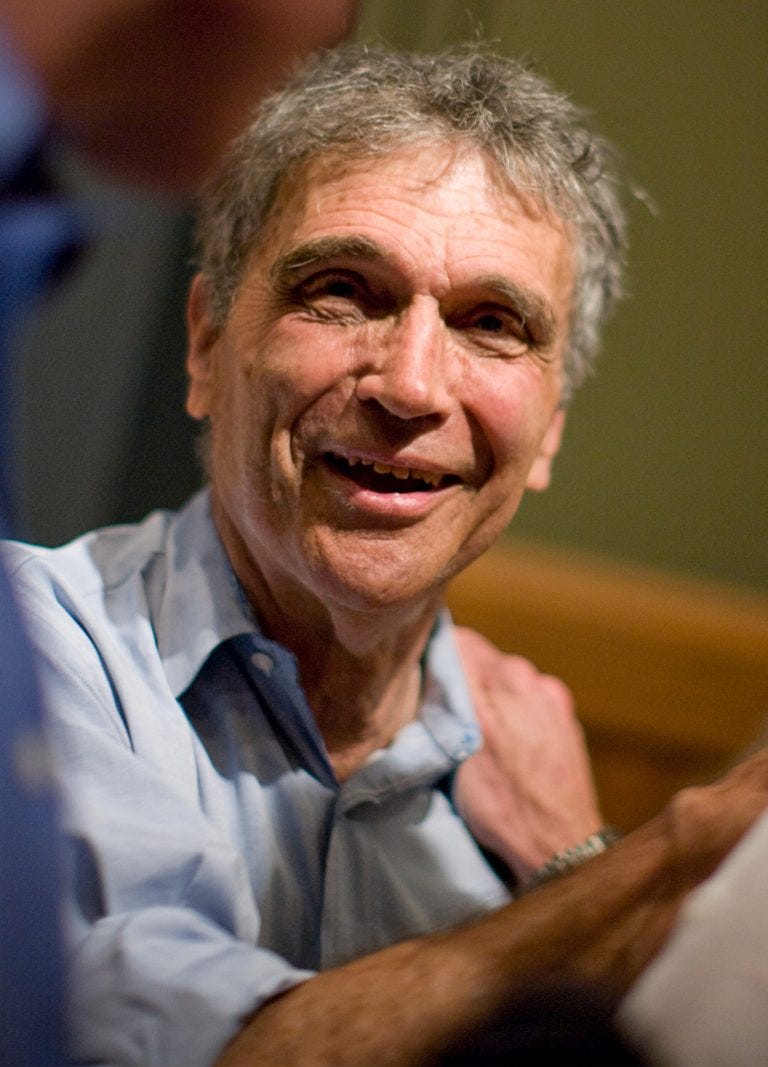
I’ve reached the age when I need to brace myself before scanning the obituary page, lest I come across the name of someone I knew personally. I recently wrote on my website about the passing of my dear friend and favorite bookseller, Warren Farha, whom Greg Wolfe eulogized here. This week, I pause to remember another man whose work and friendship altered my life for the better: Robert Coles, who died on June 4 at the age of ninety-seven.
A Harvard child psychiatrist and author of more than eighty books, Coles wrote from his own experience working with children in challenging circumstances. The first book of his five-volume Children of Crisis series, A Study of Courage and Fear, includes his weekly conversations in 1960 with Ruby Bridges, the then six-year-old girl who was the only African American student at a newly integrated New Orleans public elementary school. In response to Ruby’s presence, all the families of the formerly all-white school withdrew their children. Escorted to school each morning by U.S. Marshals, Ruby silently passed crowds of angry white protestors who shouted curses and threats at her.
On her walk to school one morning, Ruby paused, faced the crowd, and muttered a few words before heading in. When Coles questioned her about it, she said she had been talking to God. Thinking he and his patient were on the verge of a therapeutic breakthrough, Coles asked Ruby to explain. She told him that she usually said a prayer before starting out with her escorts, but had forgotten to do so that morning and made up for that omission as soon as she remembered. Coles then asked what she said during her prayer time. Ruby replied, “I ask God to forgive those people because they don’t know what they’re doing.”
Whenever Coles reached that point in the story—a tale he told often and well—he paused to note that he’d heard those words before. In the hands of a lesser observer, Ruby’s prayer might well have been dismissed as religious sentimentality, a girl parroting words heard in church that exceeded her comprehension. Coles, however, resisted the academic urge to explain away a child’s inner world or pathologize her virtues. Instead, he marveled that this six-year-old black girl proved far wiser and more resilient than he had previously imagined.
It was a classic Coles moment, charged with the compassion and humility that characterized all his work. With one foot in the academic world and the other in the messiness of daily life, he saw children as his best, most insightful teachers. His books quoted them at length from conversations held not in a therapist’s office but in the child’s home, often sitting on the floor while the two of them drew with crayon on plain white paper. Each book in the series includes some of these colorful images, works of art that Coles placed in context within the young artists’ lives. The results are revelatory and deeply moving.
Though he avoided personal statements of religious conviction, he wrote of the moral and spiritual lives of children with generosity and respect. His friends and correspondents ranged from the forgotten to the famous—the latter including William Carlos Williams, Anna Freud, Dorothy Day, Robert F. Kennedy, and Bruce Springsteen—though he didn’t let such company go to his head. He once showed me photocopies of handwritten letters he had exchanged with Walker Percy and credited their near illegibility to the fact that both writers had trained as physicians. Perhaps that explains why my long, rambling missives to him were printed from my computer while his responses were short, typewritten notes signed “Bob” at the bottom in blue ink.
When I first read his work at the recommendation of a college professor, Coles’s seemingly effortless wedding of medicine and writing led me to believe the professions were natural soulmates. In my own experience, however, they behaved more like jealous mistresses, resenting the time I spent in the other’s arms. Only now do I realize that was an excuse, a cover for my own lack of discipline. For Coles, who claimed he never set out to become a writer, his literary output was dizzying, less in spite of but because he held himself to vertiginous standards. Great books, especially those by George Eliot and Charles Dickens, served as his mentors, models, and lifelong companions. He told me he couldn’t bring himself to watch the BBC adaptation of Eliot’s Middlemarch because he knew the characters too well to allow someone else’s vision to undermine his own.
Like his therapeutic approach, his use of novels as case studies in compassion was at once unconventional and old fashioned, leaving him open to criticism for being disorganized, imprecise, and repetitive. He had no tolerance for academic abstractions or dogmatic theory. When in a moment of career anxiety I told him I was considering ditching medicine to pursue a PhD in Literature, he said, “But I thought you liked books.” He encouraged me to write instead, asking me to submit to DoubleTake, the marvelous—if short-lived—magazine of words and photography he founded and edited.
Generous and gracious, he was always on the lookout for new talent, ready to assist in honing their craft. Through telephone conversations, his gravelly voice grew comforting and familiar to me, if not to my wife. Once, when he called to do a line edit for one of my essays, Jill got to the phone first. Coles politely introduced himself, saying “This is Bob Coles,” to which Jill, suspecting a prank, said, “No you’re not!” Unflustered, he assured Jill he was indeed who he claimed to be and asked if he and I could get down to business.
I never attended Harvard, so I missed out on his legendary classes such as “The Literature of Social Reflection,” which some undergraduates mockingly dubbed “Guilt 105.” Not everyone got what Coles was up to, but he left his mark on me. Many of my career choices as a pediatrician and writer bear his fingerprints. Indeed, his greatest legacy may be found in the hundreds of lives he transformed by the shape of his own career. He confessed that his lifelong work with the marginalized and vulnerable often left him uneasy, given how privileges of class and education rendered him comparatively invulnerable. Coles’s capacity for critical self-reflection—along with his empathy and self-effacing humility—stood in stark contrast to the brazen rapacity now seen in men like Elon Musk. The world seems a crueler, less honest place without Robert Coles in it, and I’m left feeling that I failed to hold up my part of a friendship I neither merited nor fully appreciated. He was in hospice care when he died, and our last conversation—which I recall touched on our respective writing projects and where to find the best ice cream in America—happened much too long ago. We shall not soon see his like again.
Brian Volck is an author and retired pediatrician who lives in Santa Fe, New Mexico. He is the author of a poetry collection, Flesh Becomes Word and a memoir, Attending Others: A Doctor’s Education in Bodies and Words. His second poetry collection, Chora, was published this month as part of Cascade Book’s Poiema series.
We invite you to learn more about Slant Books here.
 | A guest post by
|
"But I thought you liked books"--an epic line. Thanks for this wonderful reflection, I learned a lot about this good person. I'm sorry for your loss.
I feel a great sadness; Coles was one of my heroes, a study of compassion. I agree, "we will not see his likes again," nor those of so many others who have left this earth this year. I appreciate your homage and the obvious love you have for him.