
Calling Dr. Johnson, Calling Dr. Johnson…
The perennial grief caused by our insatiable capacity for self-delusion

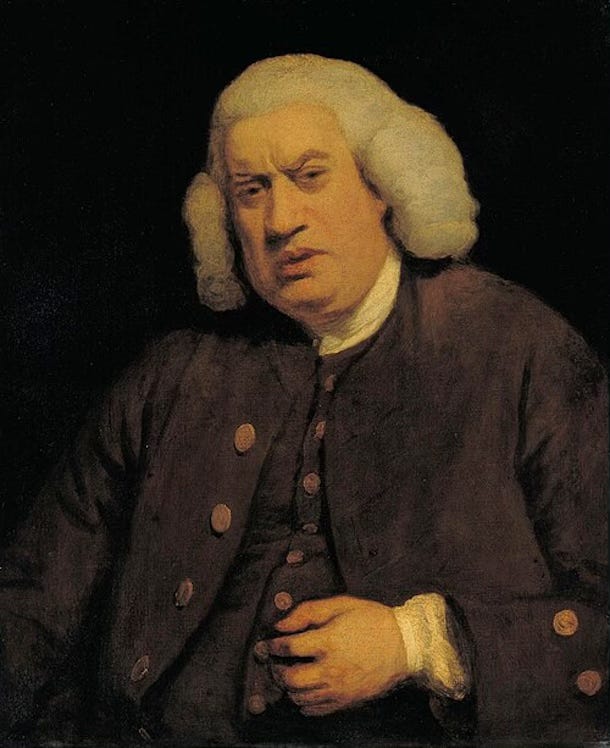
Let observation with extended view Survey mankind from China to Peru;…
Lately, these opening lines of Dr. Samuel Johnson’s “The Vanity of Human Wishes,” written in 1748, have been buzzing about in my head, especially when I’m watching the news. But they’re a welcome distraction. I don’t swat them away. In fact, I welcome their companionship in a time of fear and uncertainty.
Why would I say that? Because this 368-line poem speaks as forcefully to us now as it did three hundred years ago about what its title suggests: about the perennial grief caused by our insatiable capacity for self-delusion, especially in our quests for greatness.
The grief is perennial, so why can’t the poem’s lineage be perennial as well? After all, that lineage goes much further back than three hundred years. Johnson called his poem an “imitation” of the Roman poet Juvenal’s tenth satire, written between 100-127 AD during a previous age of imperial vanity, that of the Roman emperors. Like Juvenal’s poem, Johnson’s “The Vanity of Human Wisdom” is a satire written in a poetic meter usually reserved for the most serious subjects. For Johnson, this was the iambic pentameter of the Heroic Couplet. (Juvenal’s satire is written in dactylic hexameter, the meter used by Virgil and Lucretius.) The satiric effect of both poems comes from the use of a dignified poetic form ironically: not to honor heroes or great achievements, as was expected, but to emphasize the opposite, human overreaching and helplessness.
We hear Johnson’s elevated tone right away in that first line above: “Let observation with extensive view….” With magisterial authority (recalling God’s “Let there be light”), Johnson bids a kind of poetic eyeball to emerge from the thin air of the upper atmosphere. Then, in the second line, the obedient eyeball, like any well-placed satellite, turns to “survey mankind from China to Peru.” We, the readers, look down through the eyeball’s moving lens from that lofty perspective. And we follow the eyeball’s gaze as it swiftly passes from one end of our world to the other within that opening iambic pentameter couplet—a couplet whose authority is sealed by the vigorous stamp provided by Johnson’s otherwise improbable end-rhyming of “view” and “Peru.” (Were “view” and “Peru” ever rhymed before or since?)
Yet the opening couplet closes not with a period but a semicolon. “Observation” involves data-harvesting not so much of a visual as of a moral kind. Johnson’s command to “observation” continues:
Remark each anxious toil, each eager strife,
And watch the busy scenes of crowded life;
Then say, how hope and fear, desire and hate,
O’erspread with snares the clouded maze of fate,
Where wav’ring man, betray’d by vent’rous pride
To tread the dreary paths without a guide,
As treacherous phantoms in the mist delude,
Shuns fancied ills, or chases airy good;
How rarely reason guides the stubborn choice,
Rules the bold hand, or prompts the suppliant voice;
How nations, sink, by darling schemes oppress’d,
When vengeance listens to the fool’s request.
A period after that final, fourteenth line brings this sonorous opening command to an end. Observation has no small task ahead of it! The task involves recording how the best intentions of those teensy tiny creatures down there below continually betray them—uh, I mean “us,” for it is ourselves we’re watching! And not just ourselves individually, but ourselves as political bodies, as societies, as if the inner contradictions of each person mirror the contradictions of the society in which that person is embedded. So that for both the individual and society, the “vanity of human wishes” applies indiscriminately. Both the individual and society allow themselves to be guided by “Hope and fear, desire and hate”—rather than “reason.” And so both inevitably become captives of “fate,” as the following three couplets attest.
Fate wings with every wish th’ afflictive dart,
Each gift of nature, and each grace of art,
With fatal heat impetuous courage glows,
With fatal sweetness elocution flows,
Impeachment stops the speaker’s powerful breath,
And Restless fire precipitates on death.
The poem’s message—if this were the whole of it (it’s not)—certainly sounds gloomily pessimistic, to say the least. Why care about such a poem? The news about us, especially today, is depressing as it is. Who needs more?
And yet, after reading “The Vanity of Human Wishes” again and again over many years, and reading it again now, I don’t find it depressing at all. Quite the opposite. I find it invigorating. And that’s in large part due to its language, maybe especially to its vigorous, often surprising adjective-noun combinations. Take, for example, the adjective-noun combinations in just one line—
Remark each anxious toil, each eager strife,
What do these combinations ask us to imagine or “remark”? In “each anxious toil, each eager strife,” I don’t see particular individuals toiling and striving. I’m looking at the way individual attitudes are externalized and absorbed into—personified by— the toiling and striving themselves. And those attitudes bear the mark of vanity. The toil isn’t simply hard, it’s “anxious.” It’s moved by hope but shadowed by doubt. Similarly with “eager strife,” except that now the hope seems excessive, over-confident. But further, “strife” itself, although seemingly used here as a synonym of “toil,” and rightly so, since “strife” is derived from “strive,” is normally taken to mean “conflict,” or “violent confrontation.” It’s not heavy labor we’re talking about in “eager strife,” but riotous warfare. Johnson’s adjective-noun combinations constantly reshape and reanimate the human vanities we’re asked to “remark.”
But ingenious use of adjective-noun combinations isn’t the only reason I find the poem uplifting, despite all its darkness. I say darkness because Johnson spends much of the body of the poem cataloging one example of vanity after another, moving from general to particular ones, from the vanity of “the hireling judge” to that of Cardinal Wolsey (Henry VIII’s Lord Chancellor), who later fell from grace with the king and almost lost his head as a result. None of us escapes imprisonment by “hope and fear, desire and hate.” No wonder that we succumb to panic.
Towards the end of the poem, Johnson voices that collective state of desperation:
Where then shall Hope and Fear their objects find?
Must dull suspense corrupt the stagnant mind?
But now at last Johnson makes a crucial turn. He responds soothingly to our plight, like a doctor at the bedside of a frantic patient:
Enquirer, cease, petitions yet remain,
Which heaven may hear, nor deem religion vain.
Still raise for good the supplicating voice,
But leave to heaven the measure and the choice,
Safe in his pow’r, whose eyes discern afar
The secret ambush of a specious pray’r.
Note that we’re no longer instructed to look down, but look up, where we find ourselves already being looked at, from heaven and by heaven, for Johnson treats “heaven” as both realm and ruler. Offering a “specious pray’r” to that heaven is probably not a good idea. Johnson spends the rest of the poem suggesting better options. And concludes:
With these celestial wisdom calms the mind,
And makes the happiness she does not find.
The good Doctor moistens our brow with the perfect iambic cadence of the first line of that final couplet. Then in the second he stretches out “happiness” over its full three syllables like saying a benediction to a feverish child. I feel better already. You?
After getting his PhD in English literature, George Dardess taught close reading to his own students until his retirement. Since then he has been ordained a Deacon in the Roman Catholic Church and written several books on Muslim-Christian relations. He has also created the graphic novel Foreign Exchange.
We invite you to learn more about Slant Books here.
 | A guest post by
|
Ian— thanks so much for your comment. Dr Johnson has always been for me a soothing voice, while at the same time a challenging one. The measured ironies, the sentence rhythms all fall in place so smoothly, yet always suggest other readings, often bleaker but never sarcastic or belittling of the troubled human person.
To be taken back to Samuel Johnson, after a decade or so when his books remained unopened on my shelves, was a quietly joyful experience. I am reminded again that reading can be a time for withdrawal and listening. The formality of his language, metre and layout invites entry to that reflective space, a virtual library.
I’m not at all sure about this, but I might think a while about two sorts of reading - two sorts of text. I said ‘listening’ a moment ago. Johnson requires that kind of attention - engaged and, in a way, restrained. As distinct from the kind of text that invites participation in a conversation. Where argument is invited and you read with an eye out for the place where a knife can be inserted.
I do like your opening figure of the eyeball in the sky. It has the visuality of an engraving.