
Blue
Blue is a way the world is.

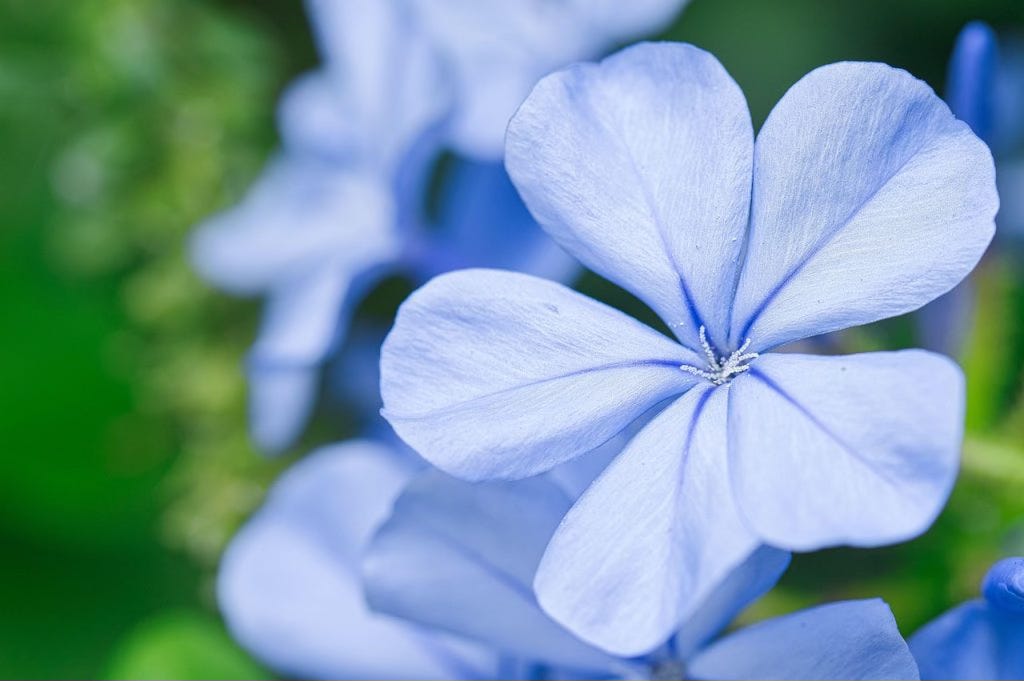
I keep coming back to the color blue. Or maybe the color blue keeps coming back to me. Or I keep getting directed and redirected to the color blue. I spent a lot of time, over the last few years, with the paintings of Joan Mitchell. There wasn’t a tree out there she couldn’t paint blue. And before Mitchell, for me, was Franz Marc. He liked to paint animals blue, especially horses. Der Blaue Reiter (The Blue Rider) became the name of the artists group and then eventually the almanac that he and Kandinsky published. The name technically refers to the rider of the horse. Kandinsky was more into riders, Marc was more into horses. But there was a lot of blue, is the point.
I also wrote about Georg Trakl and his poetry not so long ago. There, in that poetry, things become blue. Blue happens. Blue is an event in the poems. Blue is a way the world is. Blue is a color, yes, but it is also just a general truth that hangs over us. It is an adjective that sometimes becomes a noun, just a thing, a blueness that appears and asserts itself in the world. And doesn’t it even become a verb, a bluing that is itself the happening of blue? I don’t remember exactly. Maybe that’s not in Trakl. But a poet could potentially do that, could take blue from adjective to noun to verb. Let it be everything.
It’s probably the case that Trakl was himself channeling a bit of Novalis when he let blue off the leash in his poems. Novalis and his Blue Flower. The blue flower emerges in a dream in Novalis’ novel (unfinished) Heinrich von Ofterdingen. The main character dreams of finding a blue flower in a cave and then spends the rest of the novel in search of it. As Novalis describes it:
what most attracted his notice, was a tall, light-blue flower, which stood nearest the fountain, and touched it with its broad, glossy leaves. Around it grew numberless flowers of varied hue, filling the air with the richest perfume. But he saw the blue flower alone, and gazed long upon it with inexpressible tenderness.
And Novalis, it seems, had himself been inspired to think of his blue flower by reading a novel by Jean Paul, who, like Novalis, also had in his mind some of the old German folktales about a peasant wandering in the mountains who comes across a blue flower. The blue flower leads him into a secret cave where he finds a lost treasure, perhaps the treasure of ol’ King Barbarossa, the medieval king who died in the crusades.
The dark spaces of caves and the search for the blue flower. Is it blue inside of caves?
It is often said that Novalis’ blue flower is a kind of symbol for Sehnsucht, which is a hard word to translate precisely into English. The most common translations are “yearning” and “wistful longing.”
When I think of the blue inside a cave or outside, walking in a forest or across a meadow in the moonlight, when I think of that kind of light, that sort of illumination that also has a darkness to it, it comes with a kind of mood. The mood is indeterminate, alert but also diffused. That sort of blue light, even in its softness, does actually bring a certain clarity, but it is a clarity through which many details are lost. I don’t necessarily see all the objects in the meadow or in the cave. What I do see, which I might not have seen in the bright resolution of the sunlight, is the blurry boundaries between all the individual elements. Or maybe I don’t see that exactly. I am aware of it. I am aware of the meadow as an undulation that is uninterrupted by any of its particularities. It has its particularities within it, it is denser here and lighter and more opened up over there. It is full of tree shapes on the one side and then those give way to an indeterminate underbrush over beyond the tree shapes. But these are all undulations more than boundaries. The meadow is held together by something that is not itself visible. What color is that holding-together? It is blue.
I’m in the blue when I am wandering the meadow in the moonlight, on a certain a kind of night, a night that has a nice big moon in it, a moon that refracts the otherwise overwhelming light of the sun and gives it to me as a second-light, a light that obscures almost equally as much as it reveals. This is a place with many shadows. The shadows are never pure darkness. Shadows do not equal the inability to see. In fact, the removal of areas of light, the falling into shadow, is also an aspect of revelation. The shadows bring a focus, but the focus is not complete. The absences within the shadows are part of the focus. I grasp the ‘whole’ of whatever I am perceiving that much more intuitively when it has the proper amount of shadow, of not-seeing, of not-directly-revealing. The shadows are blue.
Is there a color for the experience of being completely and totally surrounded by something and simultaneously feeling that that which you are utterly within is also infinitely receding? Yes, there is a color for that.
Once when I was shedding bitter tears, when, dissolved in pain, my hope was melting away, and I stood alone by the barren mound which in its narrow dark bosom hid the vanished form of my life—lonely as never yet was lonely man, driven by anxiety unspeakable—powerless, and no longer anything but a conscious misery.—As there I looked about me for help, unable to go on or to turn back, and clung to the fleeting, extinguished life with an endless longing:— then, out of the blue distances—from the hills of my ancient bliss, came a shiver of twilight— and at once snapt the bond of birth—the chains of the Light. (Novalis, Hymns to the Night)
Morgan Meis has a PhD in Philosophy and is a founding member of Flux Factory, an arts collective in New York. He has written for n+1, The Believer, Harper’s Magazine, The Virginia Quarterly Review and is a contributor at The New Yorker. He won the Whiting Award for non-fiction in 2013. Morgan is also an editor at 3 Quarks Daily, and a winner of a Creative Capital | Warhol Foundation Arts Writers grant. A book of Morgan’s selected essays can be found here. His books from Slant are The Drunken Silenus. The Fate of The Animals, and The Grand Valley He can be reached at morganmeis@gmail.com.
 | A guest post by
|
Morgan, I see you working towards a "blue style," one that enacts a blurring of its own focus, or the yielding up of rhetorical control— reminding me of what Emerson set out to do with the essay form, inspired by Montaigne, to write "ahead" of the thought, not in the wake of it. You are striving to do what Joan Mitchell was trying to do with paint ("try" in the sense of "test," because by definition there can be no "product" here, no finished surface. Blue makes no claim, as the other colors do.
I like this, Morgan, especially the idea of blue as a verb. Night blues a forest (just google 'forest at night' to see the transformation.) Your 'meadow in the moonlight' brought to mind the Schumann song, Stille Tränen, from a poem by Justinus Kerner: The sleeper awakes at night and wanders through the meadow, under a sky that is 'wonderblue'). And here's a recording by Thomas Hampson: https://www.youtube.com/watch?v=uikUYImqgCA
Stille Tränen
Du bist vom Schlaf erstanden
Und wandelst durch die Au’,
Da liegt ob allen Landen
Der Himmel wunderblau.
So lang du ohne Sorgen
Geschlummert schmerzenlos,
Der Himmel bis zum Morgen
Viel Tränen niedergoss.
In stillen Nächten weinet
Oft mancher aus den Schmerz,
Und morgens dann ihr meinet,
Stets fröhlich sei sein Herz.
Silent Tears
English translation © Richard Stokes
From sleep you have risen
And walk through the meadow.
Everywhere lies
Heaven’s wondrous blue.
As long as, free of care, you have
Been slumbering, free of pain,
Heaven has, till morning,
Poured down many tears.
Often on silent nights
Many a man weeps his grief away,
And in the morning you imagine
His heart is ever happy.