
Angelus Novus
It’s a terrible painting, I thought.

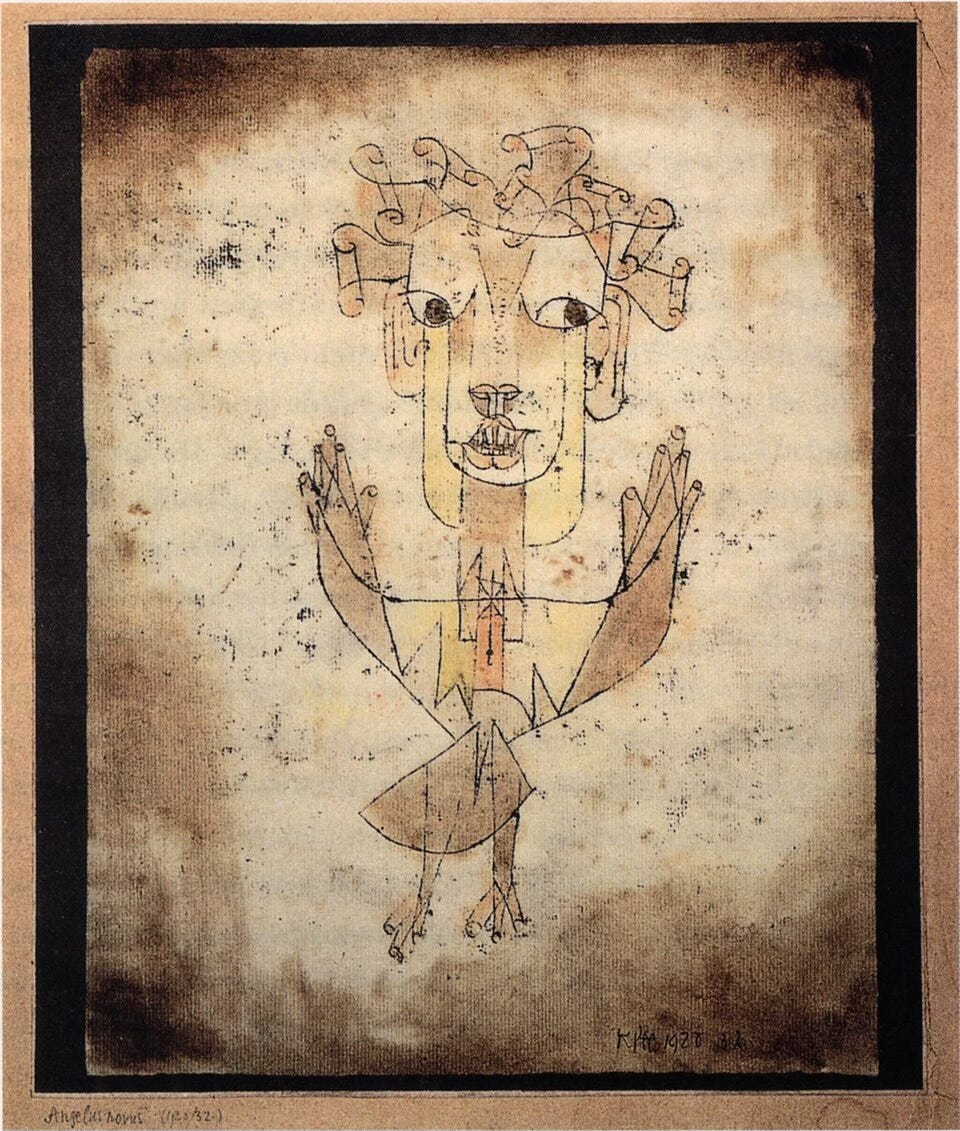
In 1920, the Swiss artist and all around maniac of wandering lines, Paul Klee, painted a work that came to be known as the Angelus Novus. I’ll tell you a somewhat shameful story about the history of this painting and the history of me. I learned about the painting by reading Walter Benjamin, as have many. The Angelus Novus appears and plays an important role in Benjamin’s Theses on the Philosophy of History.
In my college years, I was so taken with the stories around the painting and with Benjamin’s analysis of it that I titled a youthful novel Angelus Novus. I thought I was being amazingly cool and sophisticated in doing so. I was, if I remember correctly, nineteen years old. No, the novel is not very good, although it was published by an indie/punk rock press in the East Village at the time called Soft Skull. Really I can’t be blamed too much for the pretentiousness. The Angelus is a seducer and the stories around the Angelus are irresistible to any young high-minded, taking-oneself-too-seriously sort of person.
Here are a few tidbits. The painting was made with a technique that I think Klee developed himself where there was a first image made in oil paint and then transferred over to another piece of paper where watercolor was added. I don’t really understand exactly how that was supposed to work, to be honest. But I love the fact that the painting is sort of a drawing and sort of oil and sort of watercolor and so fragile that it really isn’t supposed to be moved or exposed to any light for very long. More on that in a minute.
Anyway, Benjamin saw the painting and wanted it but had no money and so convinced Ernst Bloch, another Frankfurt School philosopher, to buy it for him. Why did Ernst Bloch have money? I’d have guessed that Bloch had the least money of all of them. But no matter. Benjamin got the painting and hung it in his room and declared it the best thing ever. Bloch was, at the time, working on his book about the radical theologian Thomas Müntzer, by the way. And I guess it was more recently discovered that Klee actually painted the Angelus Novus over an older engraving of Martin Luther, based on a Cranach portrait.
Later, the painting ends up with Gershom Sholem for some time and then with Georges Bataille. You can’t make these sorts of things up. The painting is basically spending time with all the figures of twentieth century mysticism and that weird mash-up of theology, Marxism, revolutionary theory, apocalyptic fears and yearnings, millennial fascinations, Kabbalah, etc. Benjamin is meanwhile basically on the run from the Nazis and will tragically end his own life in the process of this flight.
I haven’t even gotten to the embarrassing part as regards my own history with the painting. The thing is, I’d only ever read about the painting in the works of Benjamin and others. I’d never seen it. Definitely not in person and actually not even in reproduction. This was the early nineties, so I couldn’t just look it up online. So what I did instead was to form my own picture, my own mental fantasy of what it must have looked like. And then, sometime later, maybe a year or so later, I finally found a book that had a photo of the Angelus Novus. And I was very upset.
It’s a terrible painting, I thought. It’s not what I wanted it to be at all. It didn’t look like the image in my head. And I couldn’t stand the sort of curly cue hair and hands. It seemed too childlike as a drawing. Here’s the thing. I don’t actually remember anymore what I wanted the painting to look like. I just remember being in a state of shock when I looked at the photo and realized I had been writing about and fantasizing about this.
I have since of course come to appreciate Klee and to appreciate the drawing/painting. I get it now. Really, I actually do. I love the mouth, the crazy teeth, the weirdly sensuous bottom lip and the dinky bird feet and legs. I learned to understand why it was great and why Benjamin loved it so much. But I didn’t understand it for many years. I hated the painting for many years and hated to hear mention of it and hated to ever see images of it. For many years. I hated the Angelus Novus.
And then I began to love it again, the real drawing/painting, not the one in my head. When I realized how deeply the painting had embedded itself in my own life story, I wanted to see it actually in person. But for many years it was basically impossible to do so.
Scholem gave the painting to the Israel Museum in Jerusalem. And by the way, Theodor Adorno had it for some time before that. But it ended up in Jerusalem, as such an angel must, I suppose. And it was never really on display because it is so fragile. And then, for the current Paul Klee show at the Jewish Museum in New York, they decided to take it out of hiding and display it. And I was in New York in early May and could have gone to see it. Except that somehow this bit of information never crossed my desk. I didn’t know it was there. I went to New York and missed the Angelus Novus.
Except that, it wasn’t there. Because of its fragility and because of the war with Iran and other difficulties it actually didn’t make it out of Jerusalem. So it wasn’t there when I was in New York. And then, a week after I left New York, the situation stabilized and it was finally shipped to the Jewish Museum Exhibit. It is there now. It waited for me to leave, and only when I was gone did it appear.
Morgan Meis has a PhD in Philosophy and is a founding member of Flux Factory, an arts collective in New York. He has written for n+1, The Believer, Harper’s Magazine, The Virginia Quarterly Review and is a contributor at The New Yorker. He won the Whiting Award for non-fiction in 2013. Morgan is also an editor at 3 Quarks Daily, and a winner of a Creative Capital | Warhol Foundation Arts Writers grant. A book of Morgan’s selected essays can be found here. His books from Slant are The Drunken Silenus. The Fate of The Animals, and The Grand Valley. He can be reached at morganmeis@gmail.com.
 | A guest post by
|
This painting has had a big place in my life, or its internet representation and a coffee table book with it in it. I took the plate out of the book, cut it up and, along with some other Klee paintings, I made a collage on my 19-year-old son’s suicide (the “Angelus Novus” was its center, its core). I gave the collage to my ex-wife, upon her request, but she said she wept everytime she saw it, so she gave it to our daughter, who now has it hung in her dining room. At the year anniversary of our son’s death (twelve years ago), I showed the collage to family, with these words (including the David Milch quote):
My life has become defined by a single incident, an event with so many moving parts that to look at one of them in isolation is to throw a spoke into the wheel of the whole. I am a writer. I’m a writer with limitations. Some things I can and some things I can’t do. Only the creator God could span the entire story and hold up understanding against understanding, weighing every grain of motive and sufferance, the tragedy whole in His hand, and still choose (as is His wont) to reveal to us a quantum of the vast tapestry of our own lives. I learned a short time ago, as a person, that I’m not equal to that divine task. As a writer I learned it long ago.
David Milch: “Form predicts content and that content, when it is successful, validates the prediction of form. If at the beginning of a sequence or of a story or of an episode or the beginning of an episode which is the conclusion of an entire story, the viewer is allowed to experience a seeming disparateness at the visual level but there has been some pronouncement of faith which (is in? isn’t)? drumroll, for example, you’re coming over the clouds and gradually the feeling that builds and culminates is all those things which have seemed separate but which we have experienced rhythmically as a unity become affirmed through other senses, that unity becomes the substance in miniature of the content of the work. That isn't an abstraction or a formulation that I try to write to, it's rather the process of my working. If I talk about not working from an outline and that I pray before I begin to work which is essentially thy will, not mine be done, whoever Thy is – and I’m ready to hear in more specific detail at any time that He’s prepared to communicate it. And just let – ‘I offer myself to Thee, to build with me and do with me as Thou wilt. I pray to be relieved of the bondage of self.”
Not as part of my presentation that day is this passage from Jurgen Moltmann, why I sought out the painting in the first place: “A Klee painting named Angelus Novus shows an angel looking as though he is about to move away from something he is fixedly contemplating. His eyes are staring, his mouth is open, his wings are spread. This is how one pictures the angel of history. His face is turned toward the past. Where we perceive a chain of events, he sees one single catastrophe which keeps piling wreckage upon wreckage and hurls it in front of his feet.”
Fun post to read. Being in New York and missing it is akin to a running gag.
The painting's backstory of belonging to so many different people, particularly Benjamin, and ultimately ending up in Israel sparks my curiosity. The last big show of Klee's work I saw at the Guggenheim (it was a retrospective), so when I read about the Jewish Museum exhibit elsewhere I did a bit of reading about this particular painting, discovering that the director of the Jewish Museum, James S. Snyder, taped a brief discussion it.
My notes from watching the video: Snyder describes it as providing a narrative springboard for the entire exhibit. Part of a "family of angels Klee created over 20 years," this one, which is the first, created in 1920, is "an angel who may be looking back toward the horrors behind it, the horrors of WW I," Snyder says. Noting, moreover, that its wings are lifted - it's ascendant - Snyder adds that we might see it as "[p]erhaps being hopeful about what lies ahead." Its importance to Benjamin was as "the Angel of History, being pushed backward the future by the horrors of the past, but already knowing of the gathering storm of the rise of the Nazi era." Snyder thinks the painting "is exactly about this . . . [the angel], wide-eyed, looking at the trauma of the past and perhaps thinking about the euphoria of a different future."
Listening to Snyder, I realized I'll never look at Klee's angels, especially this one, in quite the same way again.