
Am I a Grasshopper?
A meditation on Hayim Nahman Bialik and Torah

Recently, I stood up in the middle of a meeting, said this committee is fucked, picked up my notebook and papers, and said “I’m out of here.” I don’t think I’ve ever acted like this before. A few members of the committee pleaded with me to stay. I sat down and, for the rest of the meeting, listened with as much patience and open-mindedness as I could. I also sat in shame.
*
Before chanting one of the central prayers of Judaism, the Shema, Jews read the ahava rabah prayer. It begins, in English translation, “with unbounded love you have loved us, YHVH.” Further along in the prayer, we say, וַהֲבִיאֵֽנוּ לְשָׁלוֹם מֵאַרְבַּע כַּנְפוֹת הָאָֽרֶץ, v’haveeynu l’shalom meiarbah canfot haeretz, bring us to peace from the four corners of the earth. I’ve said that prayer hundreds of times. I’ve thought about the “four corners” of our spherical earth. But, until I read that part of the prayer a few days after my outburst in a committee meeting, I was never moved by it. That morning, to my surprise and delight, those words illuminated my experience in the committee.
*
“Do you bring greetings from brothers in Sion, / distant kin who are near?,” asks Hayim Nahman Bialik in “To the Bird.” Bialik, writes Peter Cole in his introduction to the recently published book of his translations of Bialik, On the Slaughter, has a reputation as “the major figure of modern Hebrew poetry.” “To the Bird,” his first published poem, appeared in the journal Pardes, The Orchard, in 1892. When I read those lines early one morning not long ago, I experienced something similar to what happened when I read the “four corners” passage of the ahava rabah prayer. I felt a visceral connection to my “kin” in Israel at this very moment as well as to the Jews of Bialik’s time in Kishinev, site of a horrific pogrom, and Odessa, Zhitomir, Volozhin, and elsewhere in the late nineteenth/early twentieth centuries. I didn’t just read about “kin” who were at once distant and near, I felt their presence in my living room in Asheville, North Carolina, in 2026.
*
Bialik calls upon his bird to “Sing and tell me, my little bird, / of marvels in distant places.” It’s a bit hard for me to envision the “marvels” of Israel at the moment. Like many Jewish people, I’m distraught about Israel right now. In “To the Bird,” Bialik imagines an idealized place. It’s a “land of the sun,” a place “of wonders from where / spring springs eternal,” a “land where almonds and date palms bud.” Palestine, as it was called then, is the opposite, for Jews, of Russia, Ukraine, and Poland, “this cold land” from which “song won’t come, / only lament and despair,” this place where “the tide / has turned against us.”
Not that Bialik doesn’t have questions about the quality of life in Palestine, “the land where the living / fathers came to their end.” Think Abraham, Isaac, Jacob.
Has God brought Sion compassion or comfort?
Is it still a place of graves?
Of the river Jordan’s currents along with the mountains and hills, Bialik asks,
Has the heavy cloud been lifted from them,
which spread a great shadow and gloom?
*
I’m writing this on Sivan 26, 5786/June 11, 2026, a Thursday morning. The Torah portion, read by Jews around the world this week, is Shlach, NUM:13:1 – 15:41. Shlach begins, “GOD spoke to Moses, saying, ‘Send agents to scout the land of Canaan, which I am giving to the Israelite people; send someone from each of their ancestral tribes, each one a chieftain among them.’”
A few verses later, we read,
When Moses sent them to scout the land of Canaan, he said to them, “Go up there into the Negeb and on into the hill country, and see what kind of country it is. Are the people who dwell in it strong or weak, few or many? Is the country in which they dwell good or bad? Are the towns they live in open or fortified? Is the soil rich or poor? Is it wooded or not? And take pains to bring back some of the fruit of the land.”
Bialik’s bird: a scout of another age.
*
When they returned to Moses, the scouts noted that the land flows with milk and honey. And they presented bunches of grapes, fruit of the land, to Moses. However, some warned against the Jews entering the land.
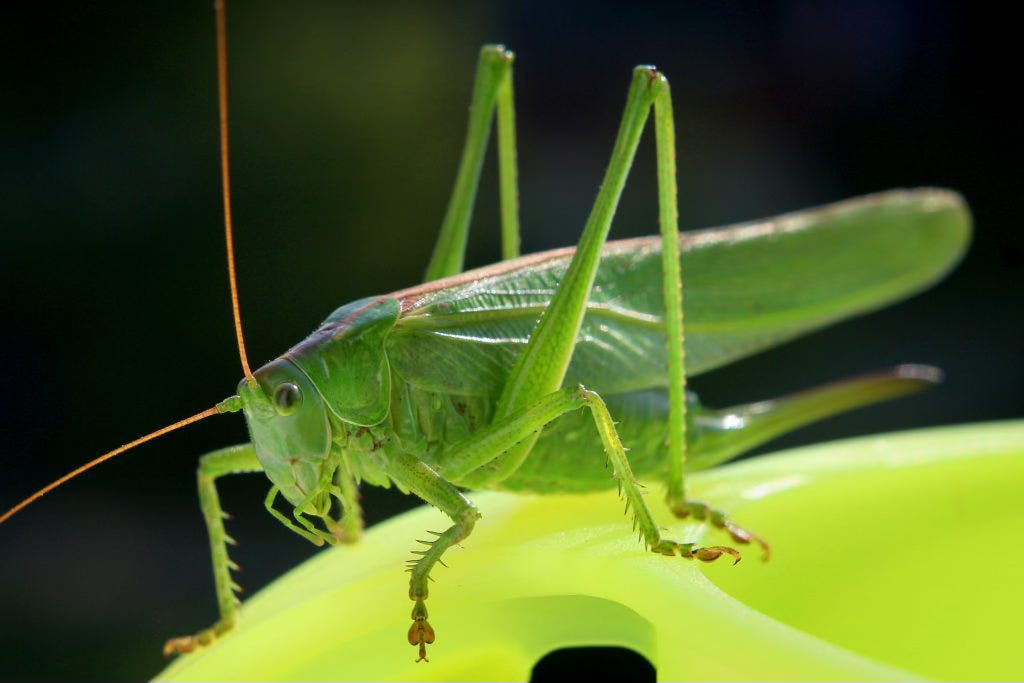
The country that we traversed and scouted is one that devours its settlers. All the people that we saw in it are of astonishingly great size; we saw the Nephilim there—the Anakites are part of the Nephilim—and we looked like grasshoppers to ourselves, and so we must have looked to them. (NUM 13: 32 – 33)
*
Among others—poets, observant Jews, even accomplished friends—I often see myself as a grasshopper. Not as smart, not as talented, not as wealthy, not as intelligent; small, weak: that’s how I see myself. Consequently, I’m often afraid to express my views, to tell my story. In that committee meeting, I perceived other members as Nephilim, giants. Ironically, because I felt—for no objective reason, I must say—threatened by them, instead of expressing my views calmly and clearly, I exploded. I acted childishly. I lashed out in a way that guaranteed I would not be listened to.
*
We pray to be gathered from the four corners. Each of us brings something of value when we come together. That’s the insight that came to me when I said that passage of the ahava rabah prayer that morning. The ahava rabah prayer leads directly into the Shema: Hear O, Israel, YHVH is Our God, YHVH is One. One tent, one nation, one people, one world, one universe, one cosmos. From the four corners, we pray to be gathered in the garden of Oneness.
When I can see creation this way, I can stop seeing myself as a grasshopper in the eyes of others. Like them, I, too, am part of creation, even though my sense of creation, informed by my experiences in the particular corner from which I am drawn, may differ from others. And the others include not only the members of that particular committee. They also include those Jewish-Israelis—government officials as well as citizens—who I believe are acting in reprehensible ways. Nonetheless, they, too, are my kin. As are Bialik and the Jews of his time and places. Distant as they are in time and space from me, they are near.
*
Bialik sang to me. I listened.
Now I am singing to you.
Richard Chess has published four books of poetry, the most recent of which is Love Nailed to the Doorpost. Professor emeritus from UNC Asheville, where he directed the Center for Jewish Studies for 30 years, Chess serves on the boards of Yetzirah: A Hearth for Jewish Poetry and Black Mountain College Museum + Arts Center, where he co-directs its Faith in Arts project. You can find him at www.richardchess.com.
 | A guest post by
|
Well said. Tiny Israel does not have the option to storm out of the “meeting”, it is geographically bound to make peace with its neighbors or perish. Someone asked if Israel has the right to exist? No, in today’s world and in the heart of the Holy Land, it only has the right to coexist. It is time for Plan B.